Project Overview
A casing for a water main was needed underneath the Mary Hill Bypass to expand service to the metropolitan Vancouver area. Michels combined proper planning, procedures, and execution to overcome issues and turn an uncertain project into a success.
Challenges
• High traffic area
• Involved in latter stages
• Cut size larger than the pipe
• Tight Deadline
• Pre-existing underground structure
• Water and sediment build-up
Solution
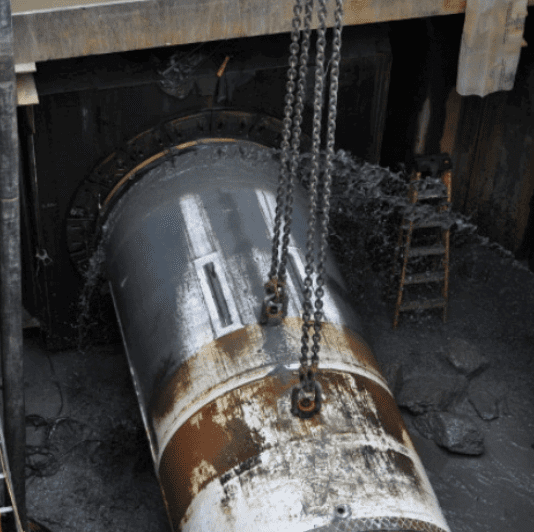
Michels was asked to join the project in the latter stages and in order to tackle the uncertain conditions, they needed to draw upon past experiences and establish procedures to mobilize the personnel and equipment safely and efficiently. Using the pre-existing launch and exit shafts that were built prior to Michels joining the team allowed for the project to stay on schedule. Modifications were made to the shaft’s shoring system to fit the MTBM and related equipment. Adjustments were also made to accommodate the Permalok pipe that had already been ordered seeing as the 15.8 mm pipe was significantly smaller than the 1,918 mm cute of the MTBM.
A specific slurry program was developed in order to accommodate the chances of having settlement around the over cut which extends up to the highway no more than 14 m above. The general contractor installed a wellpoint dewatering system to relievepressure from the base slab in the launch shaft to assist in the launch and retrieval, since the water level was located 1.5 m below the surface elevation and were influenced by Fraser River.
Outcome
The MTBM easily handled hand pressed the sandy, silty soil and gravel seams. Production was slowed at one point when undetected wooden piers were encountered but was no match for the machine. While working in an urban area it was critical to avoid existing utilities and structures which were bypassed with navigational skills and the machine’s steering systems.
The project was completed within a 9-mm variance of predetermined line and grade, far under the customer’s allowable tolerances.